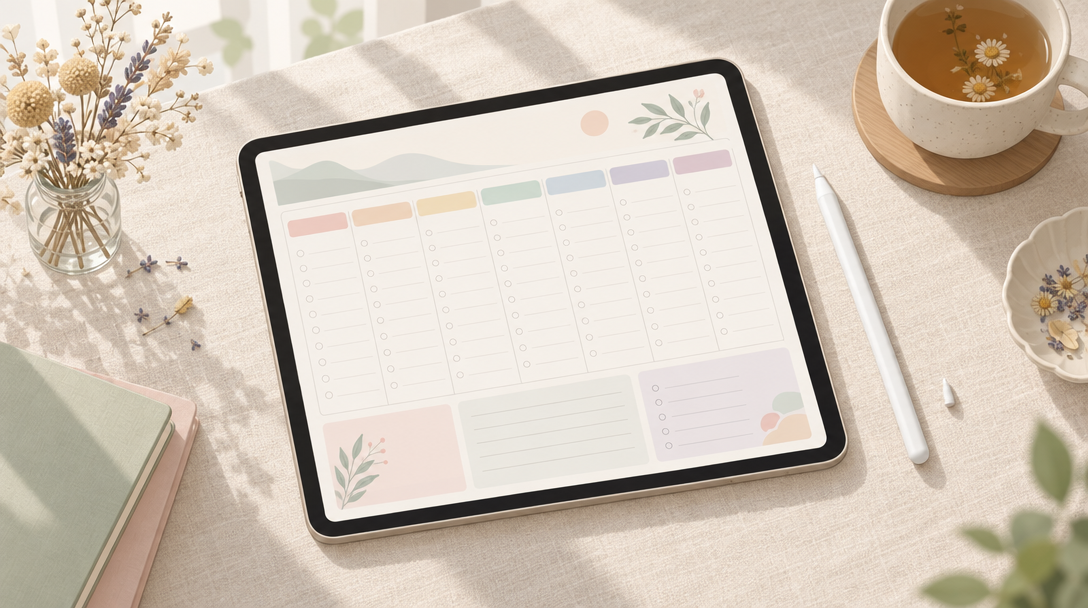
Open most digital planner setups a few months in and you will find the same thing: a habit tracker nobody has filled in since February, a mood log with three entries, a gratitude page, a water tracker, a reading log, and somewhere underneath all of it, buried on page forty, the actual week. This is tracker fatigue, and it is the quiet reason so many people abandon their planning system before spring.
I see this pattern often, and I used to live it myself. Every new tracker felt like progress. More pages seemed to mean more control. But a planner with fifteen trackers is not more organised than one with a single weekly view done well. It is simply more to maintain, and maintenance is where most systems quietly die.
The diminishing returns of adding more pages
In economics, there is a principle called diminishing marginal returns: each additional unit of something gives you less benefit than the one before it. Your first tracker, a simple weekly overview, gives you enormous value. You can see your week at a glance. Suddenly your commitments have shape.
Your second addition, perhaps a habit tracker, still helps. You notice patterns in your sleep or your exercise. Useful.
But by the time you are on tracker number eight, the marginal benefit has nearly vanished, while the cost, your time, your attention, your tolerance for upkeep, keeps climbing. You are now spending five minutes filling in pages that tell you very little, time that would have been better spent simply doing the three things that actually mattered that day.
This is not a willpower problem. It is a design problem. A minimalist weekly planner GoodNotes setup respects the fact that your attention is a scarce resource. Every page you add is a withdrawal from that resource, whether or not the page earns its keep.
“The planner that survives February is rarely the most detailed one. It is the one with the least friction.”
What a single weekly view actually needs to contain
Strip away the trackers and ask a simpler question: what does a week actually require from a page? In my experience, it comes down to five things.
1. A visible shape for the week
You need to see Monday through Sunday in one glance, not scattered across seven separate daily pages you have to tap through. This is the entire advantage of a weekly layout over a daily one: it shows you trade-offs before you make them. If Tuesday is already full, you see that before you commit to anything else.
2. Space for the three priorities that matter
Not a to-do list with thirty items. Three. Research on attention and decision fatigue consistently points the same direction: long lists dilute focus rather than sharpening it. A short, deliberate list forces you to choose, which is uncomfortable and exactly the point.
3. A place for appointments and fixed commitments
This sounds obvious, but many trackers crowd out the one thing a weekly page cannot do without: the hard edges of your week. Meetings, appointments, deadlines. These are not optional; everything else bends around them.
4. Room to jot, not log
A small note area, not a full journal page, not a mood tracker with a five point scale. Somewhere to write “call the vet” or “ask about the invoice” without opening a new page. The moment a note requires navigation, it tends not to get written at all.
5. White space
This is the one people cut first and need most. White space is not wasted space. It is what makes a page feel calm rather than demanding. A crowded page asks something of you every time you open it. A spacious one simply waits.
If you are choosing a layout for the year ahead, this is worth sitting with before you download anything. The 2027 Pastel Green Digital Planner for iPad | Planjuli was built around exactly this principle: one considered weekly spread, generous margins, and enough restraint that the page supports your week instead of competing with it.
Why more structure does not mean more control
There is a comforting illusion in a tracker heavy spread. It looks thorough. It looks like you are taking your goals seriously. But structure and control are not the same thing. Control comes from clarity on your actual priorities and from a system you return to without dread. A planner stuffed with trackers often produces the opposite: a faint guilt every time you open it and see blank boxes from three weeks ago.
This is where the economic idea of opportunity recognition (not opportunity cost, but something close to it) is worth borrowing: every page you commit to maintaining is a page you are choosing over something else. A finance tracker you never update is not neutral. It is actively taking up visual and mental space that a clean weekly view could use better.
Sara, Planjuli’s founder, puts it plainly: consistency beats intensity. A planner you open for sixty seconds every morning, five days running, will do more for your week than one you overhaul every Sunday and abandon by Wednesday. The goal was never to track everything. It was to see clearly enough to act.
How to simplify an existing GoodNotes setup
If your current planner has grown heavier than you intended, you do not need to start from nothing. A good minimalist weekly planner GoodNotes approach to simplifying what you already have looks like this.
First, open your planner and genuinely look at your last four weeks. Which pages have entries? Which are blank? Be honest rather than aspirational. The blank ones are telling you something, and it is rarely “I need to try harder.” It is usually “this page was never going to earn its place.”
Second, keep only what you used. If you have been filling in a weekly overview every single week but have not touched your mood tracker since autumn, you have your answer. Delete, archive, or simply stop linking to the page you do not need. You can read our guide on how to use a digital planner in GoodNotes if you want a refresher on navigating hyperlinks, bookmarks, and page management, all of which make this kind of tidy up far easier than it sounds.
Third, resist the urge to replace deleted pages with new ones. The instinct, when a tracker fails, is often to swap it for a different tracker rather than question whether you need one at all. Give the blank space a few weeks before deciding it needs filling.
Fourth, if your current weekly page itself feels cluttered, rather than just the pages around it, consider switching to a layout designed with restraint from the outset. The 2027 Luminous Lilac Digital Planner for iPad | Planjuli takes the same single weekly view approach, with a softer palette for anyone who wants their planning practice to feel a little gentler without losing any of the structure.
Finally, give yourself permission to use a pen and paper notebook for the overflow. Not everything belongs in your planner. A loose thought, a half formed idea, a book recommendation from a friend: these can live elsewhere, in a notes app or a scrap page, without needing a dedicated tracker of their own.
The quiet case for less
A planner is not a monument to your intentions. It is a tool you pick up most mornings, often half awake, tea in hand, Apple Pencil at the ready. The question worth asking is not “what could this page include?” but “what does this page need, so I actually open it tomorrow?”
Fifteen trackers might look impressive on a Pinterest board. One clean weekly view, used consistently, will carry you further through the year. Choose the page you will return to, not the one that looks most complete on day one.