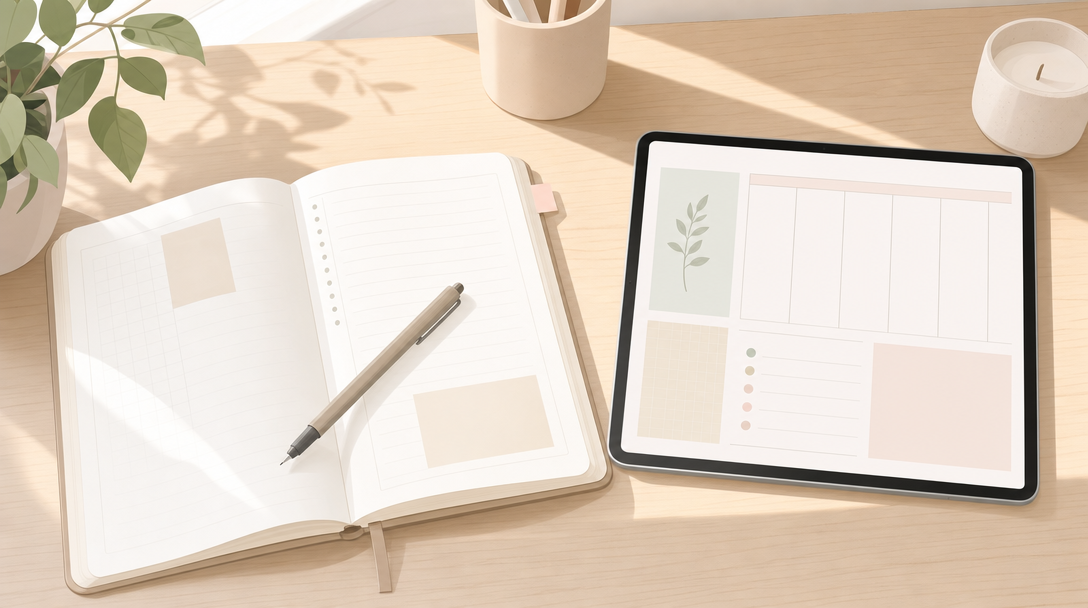
You have bought the beautiful notebook. You have also downloaded the app everyone on your feed swears by. And somehow you are still asking the same question at 11pm: should I actually be planning this on paper, or on my iPad?
This is not a trivial question in 2026. Screen fatigue is real, and plenty of people are quietly reaching for analogue tools again, not out of nostalgia but out of a genuine wish to think without a notification bar in view. At the same time, more of daily life runs through a tablet than ever before, and it feels strange to keep a separate paper system for the one part of your day meant to bring it all together. The digital planner vs paper planner 2026 debate is not really about which tool is superior. It is about which one matches how you actually think, work, and live.
Let’s look at both, honestly.
Why This Comparison Matters More in 2026
A few years ago, choosing a planner was mostly a stationery decision. Now it is closer to a lifestyle decision. iPads and Apple Pencils have become genuinely good at replicating the feel of handwriting. At the same time, many of us are trying to use technology more intentionally rather than defaulting to it for everything, which is exactly why the analogue trend has resurfaced with such force.
There is an economic idea that applies neatly here: switching costs. Once you have built a habit around a system, whether that is a leather-bound diary or a GoodNotes template, moving away from it carries a real cost, not just in money but in the friction of relearning a routine. That is why so many people stay loyal to whichever planner they started with, even when a better fit exists. Knowing this helps you make the choice with your eyes open, rather than out of habit or sunk cost.
What Paper Planning Does Exceptionally Well
There is a reason paper has never disappeared, despite decades of digital alternatives.
Tactile satisfaction
The drag of a pen across textured paper, the sound of a page turning, the visual record of your own handwriting improving or changing over the years: these are sensory experiences no screen fully replicates. For some people, this tactile feedback is what makes planning feel real rather than performative.
Zero distraction
A paper planner cannot buzz with a message while you are trying to write your priorities for the day. There is no app switching, no tempting Safari tab open behind your to-do list. If your attention is easily pulled in ten directions, this single-purpose quality of paper is not a small thing. It is arguably its greatest strength.
No app required
No software update, no sync issue, no battery to charge. You open the notebook and you write. For anyone who wants planning to be immediate and uncomplicated, this simplicity is genuinely hard to beat.
What Digital Planning Does Exceptionally Well
Digital planning has matured well beyond a novelty. In 2026, it solves real, specific problems that paper cannot.
Searchability
Try finding a note you made in March inside a paper notebook from eight months ago. Now imagine typing two words into a search bar and finding it in seconds. This alone changes how useful your past planning becomes, because it stops being a closed chapter and becomes a resource you can actually return to.
No waste, endless structure
One PDF template can be duplicated infinitely. Made a mistake, want to try a new layout, need next year’s version. With a digital planner for iPad, you are not buying a new physical product each time your system evolves. You simply adjust the file.
Portability
One iPad can hold your daily planner, your reading journal, your project notes, and your reference documents, all in a single lightweight device you were likely carrying anyway. There is no need to choose which notebook to bring today.
Handwriting, preserved
This is the detail that convinces most sceptics. With an Apple Pencil and an app like GoodNotes, Notability, Xodo, or Squid, you are still handwriting. The pen still feels like a pen. You get the cognitive benefits associated with handwriting, alongside the editability and searchability of digital tools. It is genuinely the best of both, which is precisely why demand for a well-made GoodNotes digital planner has grown so steadily.
As Sara, Planjuli’s founder, puts it:
“People assume digital planning means giving something up. In my experience it is closer to a trade-off worth making consciously: you gain flexibility and searchability, and in exchange you are simply asking your hand to write on glass instead of paper. For most people, that trade is a good one. For some, it genuinely is not. Both answers are valid.”
The Hybrid Approach
Here is something rarely said plainly: you do not have to choose only one.
Many people who plan well use both, deliberately. A paper notebook for morning pages or unstructured thinking, where distraction-free writing matters most. A digital planner for anything that benefits from structure, reuse, or searchability, such as project tracking, habit logs, or long-term goal setting.
This is not indecision. It is allocation. In economics, this mirrors the idea of comparative advantage: you assign each tool to the task it handles best, rather than forcing one system to do everything adequately. Paper for reflection, digital for structure, is a completely legitimate system, and one many of our own customers describe when they tell us how they actually plan their weeks.
How to Decide Honestly
Forget the aesthetics for a moment, and forget what is trending on Pinterest. Ask yourself three practical questions instead.
- Do you already carry an iPad or tablet daily, or would adding one just be another device to manage?
- Does searching past notes matter to you, or do you rarely look back once a page is written?
- Are you someone who is genuinely distracted by having a screen nearby, or does that risk not apply to you in practice?
Your honest answers matter more than any trend cycle. Diminishing returns apply here too: adding more tools, more templates, more systems rarely improves your planning past a certain point. What actually helps is choosing fewer tools and using them consistently. A single well-chosen digital planner, used daily, will outperform three abandoned paper notebooks and two half-finished apps every single time.
If you decide digital planning fits your life, the season itself offers a natural entry point. Many people use the run into Q4 as a moment to reset their systems before the new year properly begins, choosing a fresh layout and starting again with intention rather than waiting for January. If that resonates, the September Reset Journal for Goodnotes | Planjuli was designed with exactly that transition in mind: a calm, undated way to close out the year with clarity rather than clutter.
Where Planjuli Fits
If you land on the digital side of this decision, or the hybrid side, the tools you choose matter as much as the decision itself. A cluttered, over-designed digital planner can recreate the same overwhelm you were trying to escape from paper in the first place. Planjuli’s collection was built around the opposite instinct: offline-first, distraction-free layouts made specifically for GoodNotes, Notability, and similar apps, designed to feel closer to paper than to software. You can browse the full range of planners and journals if you would like to see what a considered digital system actually looks like on the page.
A Closing Thought
There is no universally correct answer to digital planner vs paper planner in 2026. There is only the answer that is correct for how you actually live, work, and think. Choose based on your habits, not on what looks best in a flat lay. Whichever you choose, the goal remains the same: a system quiet enough to disappear into the background, so you can get on with the things that actually matter.