You have noticed it too. The Pen Pals videos. The wax seals. The friend who now writes letters instead of texting. Somewhere in the last few years, handwriting stopped being the thing you did because you had no choice, and became the thing people choose on purpose.
That shift matters, and it is worth understanding properly before you decide what to do with it.
Why Handwriting Means Something Different Now
For most of history, handwriting was simply how things got done. You wrote because there was no other way to write. It carried no particular meaning, because it had no alternative.
That changed the moment typing became the default. Once we could type faster than we could write, handwriting stopped being necessary and started being a decision. And decisions, unlike defaults, say something about the person making them.
This is where my economics brain switches on. In markets, we talk about signalling: the way an action communicates something about you precisely because it was costly or inconvenient to do. A handwritten letter signals care because it took longer to write than an email. A handwritten journal entry signals presence because you could have typed it in half the time. The slowness is not a flaw in handwriting. It is the point.
The “Pen Pals” revival, the rise of fountain pen communities, the return of commonplace books and reading journals, none of this is nostalgia for its own sake. It is a quiet rebellion against frictionless, forgettable digital noise. People are choosing a small amount of friction deliberately, because it makes the result feel more like theirs.
A Considered Choice, Not a Default
There is a meaningful difference between doing something because it is the only option and doing it because you have weighed the alternatives and chosen it anyway. Handwriting a to-do list in 2026 is the second kind of act. It says: I had faster options, and I chose this one because it serves me better.
That is a more interesting habit to build than most productivity advice admits. Sara, Planjuli’s founder, often returns to the idea that optimisation is not about doing everything efficiently. It is about choosing, deliberately, where your attention goes. Handwriting is a small, repeatable way of practising that choice daily.
“Handwriting is one of the few habits left that cannot be automated or outsourced,” says Sara. “Every time you choose it, you are choosing attention over convenience. That is a rarer decision than it used to be, and rarer things tend to matter more.”
Where the iPad and Apple Pencil Fit In
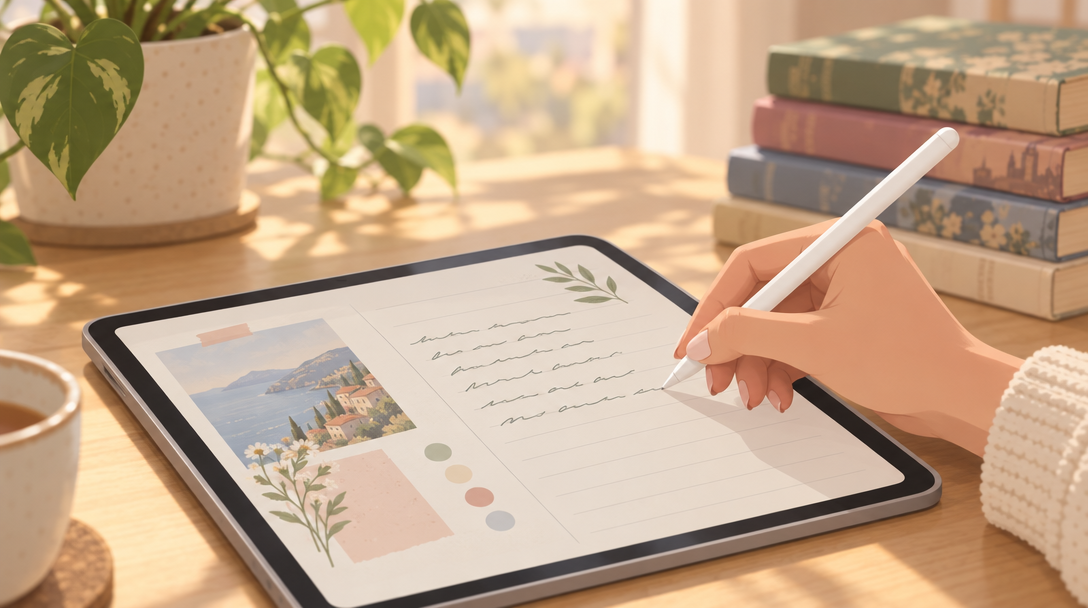
Here is the part that surprises people: the handwriting habit iPad Apple Pencil combination is not a compromise between analog and digital. It is the resolution of a false choice.
Paper enthusiasts worry that digital tools flatten the tactile, considered quality of handwriting into something disposable. Fair concern, if you are talking about typing in a notes app. But writing by hand with an Apple Pencil on an iPad is still handwriting. The pen still moves at the speed of thought. Your letters are still imperfect and recognisably yours. What changes is what happens to the page afterwards.
With a paper notebook, that imperfect, considered page sits in a drawer until you lose the notebook or run out of room. With an iPad journal, the same handwritten page is searchable, backed up, reorderable, and still entirely yours, written in your own hand, at your own pace, with the pen tilted the way you like it. You get the signal and the sentiment of handwriting, without the practical cost of boxes of old notebooks you can never quite find again.
This is not an anti-paper argument. It is an argument for choosing your tools with intention rather than defaulting to whichever app happens to be open. If you want to go deeper on this distinction, we have written at length about what it actually means to use intentional tech, not anti-tech, which is really the philosophy underpinning everything Planjuli makes.
Why the Device Does Not Undo the Meaning
Sceptics sometimes assume that because an iPad is a screen, anything written on it is automatically less present, less considered, less real. But the signalling value of handwriting comes from the deliberate slowness of forming each letter by hand, not from the material the letters land on. Your hand still has to move. Your thoughts still have to slow to match your pen. That is where the benefit lives, and a well-designed digital journal preserves it completely, while adding the practical benefits paper cannot offer.
Making the Habit Realistic, Not Aspirational-Only
There is a risk with any aspirational habit: it becomes something you admire rather than something you do. Beautiful handwriting videos are easy to watch and easy to never replicate. The gap between admiring a habit and keeping one is where most people quietly give up.
The fix is not more motivation. It is a lower barrier to starting. A few honest observations from how this habit tends to actually stick:
- One handwritten page a day beats an ambitious, unsustainable daily journalling ritual you abandon by February.
- A guided prompt or structured layout removes the blank-page hesitation that stops most people before they start.
- Consistency compounds. A single considered page, repeated daily, becomes a genuinely useful record of a year within a few months. Intensity does not compound the same way; a frantic week of journalling followed by two months of silence leaves you with very little.
If you want a structured way in, something designed specifically to lower that barrier, the September Reset Journal for Goodnotes | Planjuli was built around exactly this principle: short, guided, handwritten reflection that does not demand perfection or volume, just presence. It is a sensible starting point if the blank page has been the thing holding you back.
Choosing Tools That Respect the Habit
The planner or journal you choose matters more than people assume, because the right layout removes decisions you do not need to be making at 9pm when you are tired and simply want to write. A page with too many sections becomes a chore. A page with too few becomes aimless. Something in between, warm, considered, unfussy, tends to outlast anything overdesigned. If you are setting up your year properly and want a planner that pairs naturally with a handwriting habit, the 2027 Warm Ivory Digital Planner for iPad | Planjuli was designed with that balance in mind: enough structure to guide you, enough space to let the pen do the thinking.
The Quiet Case for One Page a Day
There is a concept economists call diminishing returns: the tenth hour of anything rarely teaches you as much as the first. Handwriting works in the opposite direction, at least at the start. The first page teaches you very little. The thirtieth page, written in a slightly looser hand, with your own shorthand starting to emerge, starts to feel like something genuinely useful. The marginal value of each additional page increases for a while before it levels off, which is the reverse of what most habits do.
That is worth sitting with. The habit does not need to be impressive on day one. It needs to still exist on day thirty.
So here is the gentle invitation, not a challenge, not a 30-day plan with a tracker and a reward system. Just one handwritten page tomorrow morning, on paper or on your iPad, with your Apple Pencil resting at whatever angle feels natural. See what it is like to choose the slower option on purpose, for its own sake, rather than because it was the only one available. That, more than any system or app, is what the current handwriting revival is actually about.