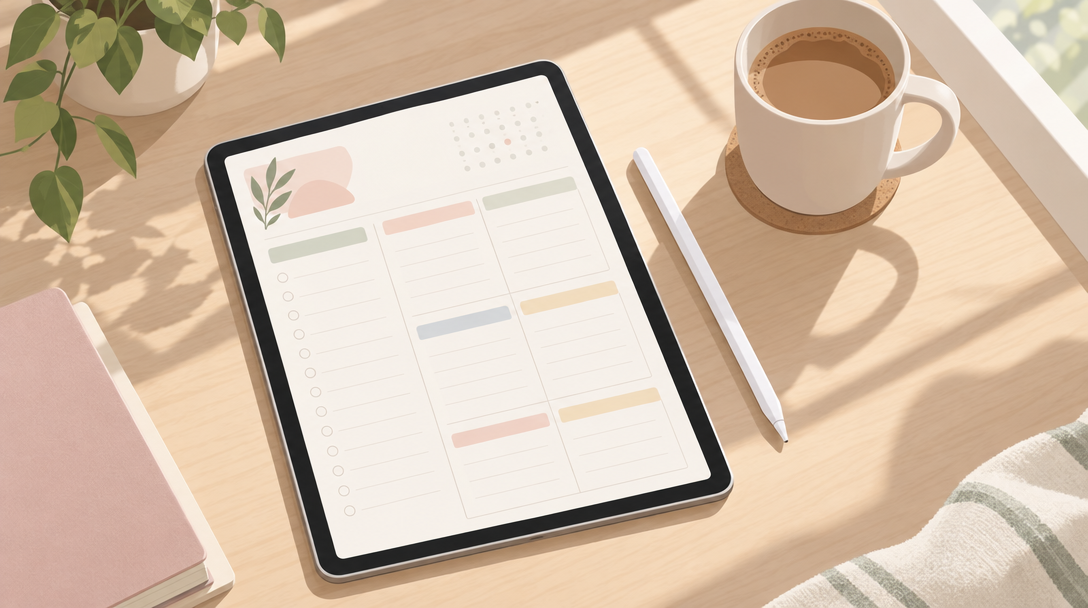
Most planning habits die within three weeks. Not because the planner is wrong, but because the routine built around it asks for too much too early. A forty-minute Sunday reset, seven trackers, a colour-coded system that looks wonderful on day one and feels like a chore by day twelve. By the time October rolls around, the planner sits closed on the shelf, or worse, open but untouched for days.
I want to offer something smaller. A six minute session, done each morning, with your coffee still warm. This is how to use a digital planner in GoodNotes without it becoming another thing you have to keep up with. The session is short enough to survive a busy week and structured enough to actually change how your day unfolds.
Why Short and Consistent Beats Long and Occasional
There’s a principle I come back to often, something I call the Tiny Consistency Loop. It borrows from a basic economic idea: compounding. A small action repeated daily produces more over a year than a large action repeated rarely, because consistency builds momentum, and momentum reduces the energy cost of starting each time.
Think of it this way. A forty-minute planning session, done twice a month because that’s all you can sustain, asks you to rebuild context from scratch each time. You’ve lost the thread of what mattered last week. You’re reconstructing priorities rather than simply continuing them. A six-minute session, done daily, never asks you to rebuild anything. Yesterday is still fresh. Today’s priorities are an extension of yesterday’s, not a fresh negotiation with yourself.
There’s also a cost most people underestimate: the switching cost of starting a habit from zero. Each time you abandon a system and return to it, you pay a mental tax, remembering how it worked, why you liked it, where you left off. A short daily habit avoids that tax almost entirely, because it never truly stops.
“Consistency beats intensity. Not because intensity doesn’t work, but because it rarely survives contact with an ordinary Tuesday.”
The Six Minute Session, Step by Step
Here is the structure I use most mornings, written out simply enough that you could start tomorrow without any setup beyond opening your planner.
Minute One: Date and Intention
Open your digital planner and write the date by hand with your Apple Pencil. This sounds trivial, but the physical act of writing signals to your brain that planning has begun, the same way opening a paper diary used to. Alongside the date, write one word or short phrase for how you want the day to feel: focused, gentle, productive, unhurried. This isn’t a goal. It’s a tone-setter, and it shapes the decisions you make for the rest of the day without you noticing.
Minutes Two and Three: Three Priorities
Resist the urge to list everything. Write exactly three things that matter today. Not three categories, three actual tasks. If you’re using a layout with a dedicated priorities section, this takes seconds. If not, a simple numbered list at the top of the page does the job.
Three is deliberate. It respects the fact that your attention is a scarce resource, not an infinite one. Most people can genuinely focus on two or three meaningful things in a day. Everything beyond that becomes background noise, competing for the same limited attention and diluting progress on what actually counts.
Minute Four: The Leftover Task Check
Glance back at yesterday’s page. Was there one task that didn’t get done? Bring it forward, but only if it still matters. This is where the economic idea of sunk cost becomes genuinely useful. Just because a task has been sitting unfinished for three days doesn’t mean it deserves a fourth day of your attention. Ask honestly: would I add this task today if I were seeing it for the first time? If not, let it go without guilt. Carrying tasks forward out of obligation rather than relevance is exactly how planners become cluttered with things nobody actually intends to finish.
Minute Five: A Quick Scan of the Day Ahead
Look at your calendar or any fixed commitments. Not to plan every hour, just to notice where the gaps and pressure points are. This takes thirty seconds and prevents the common problem of writing a lovely list of priorities that quietly ignores a 2pm meeting that eats your whole afternoon.
Minute Six: Close the Planner
This step matters more than it sounds. Closing the planner, physically or by locking your iPad, is a signal that planning is finished and doing can begin. Without this boundary, planning quietly extends into endless tweaking, rearranging, and second-guessing, which defeats the purpose of keeping the session short in the first place.
Why GoodNotes Suits This Routine
If you’re wondering how to use a digital planner in GoodNotes for something this quick, the answer is: keep the page simple and keep your tools close. A favourites toolbar with just your pen and a highlighter saves you from hunting through menus mid-session. Duplicate your daily page as a template so you’re never starting from a blank canvas. And resist the temptation to add decorative elements every morning. They belong in a slower, separate creative session, not inside your six minutes.
The beauty of planning offline, by hand with Apple Pencil, is that there’s no notification pulling you sideways mid-session. No app switching, no scrolling. Just the page, the pen, and six minutes of quiet decision-making before the day takes over.
If you want a slower, more reflective version of this same habit for the start of a new month or season, the September Reset Journal for Goodnotes | Planjuli offers a gentler structure for that kind of check-in, without asking for more time than you have to give.
When the Six Minutes Aren’t Enough
Some mornings will need more than six minutes, and that’s fine. A Monday might call for a proper weekly look-ahead. What it shouldn’t require is redesigning your entire system every time life gets busier or calmer. If you’ve ever abandoned a planner because it had too many moving parts, you’ll likely find more success with a layout that does less, deliberately. We’ve written before about why one clear weekly view beats fifteen trackers, and the same logic applies here: simplicity isn’t a compromise, it’s what makes the system survivable on an ordinary week.
A Layout Built for This
The session above works with almost any page, but it works best with one designed for exactly this rhythm: a date field, space for a handful of priorities, and room for anything left over from yesterday. Our daily planner was built with this kind of morning in mind, simple enough to open and close in minutes, without sacrificing the structure that keeps a day from sliding into chaos.
Closing Thoughts
The six-minute session won’t look impressive on Pinterest. There’s no elaborate spread, no satisfying colour-coding, no dramatic before and after. What it offers instead is something quieter and more durable: a habit you can actually keep. Learning how to use a digital planner in GoodNotes doesn’t require mastering every feature or building the perfect system on day one. It requires choosing a small routine and returning to it, morning after ordinary morning, until it stops feeling like a task and starts feeling like simply how your day begins.